Originally developed by Absolutist and released on March 26, 2001, Bubble Shooter debuted as a standalone desktop title before being ported to Adobe Flash and later HTML5, inspired directly by Taito's 1994 arcade classic Puzzle Bobble.
Bubble Shooter turns one simple move into a tense little puzzle: you aim a cannon, fire a colored bubble, and try to burst clusters before the board creeps down on you. Every shot counts, and a careless miss pushes the ceiling closer. The idea is easy to grasp, yet the best players read the whole grid before they fire.
Absolutist released the game in 2001, and it still plays well in a modern browser. You steer with the mouse or a tap, so you can start a round in seconds. The challenge comes from angles, color planning, and knowing which bubble holds the rest of the board up.
This guide walks through the shooting rules, the miss counter, scoring, the game's history, and the habits that keep a board healthy. Ready to test your aim? Start playing Bubble Shooter here and try each tip as you read.
Targeting and Cluster Mechanics in Bubble Shooter
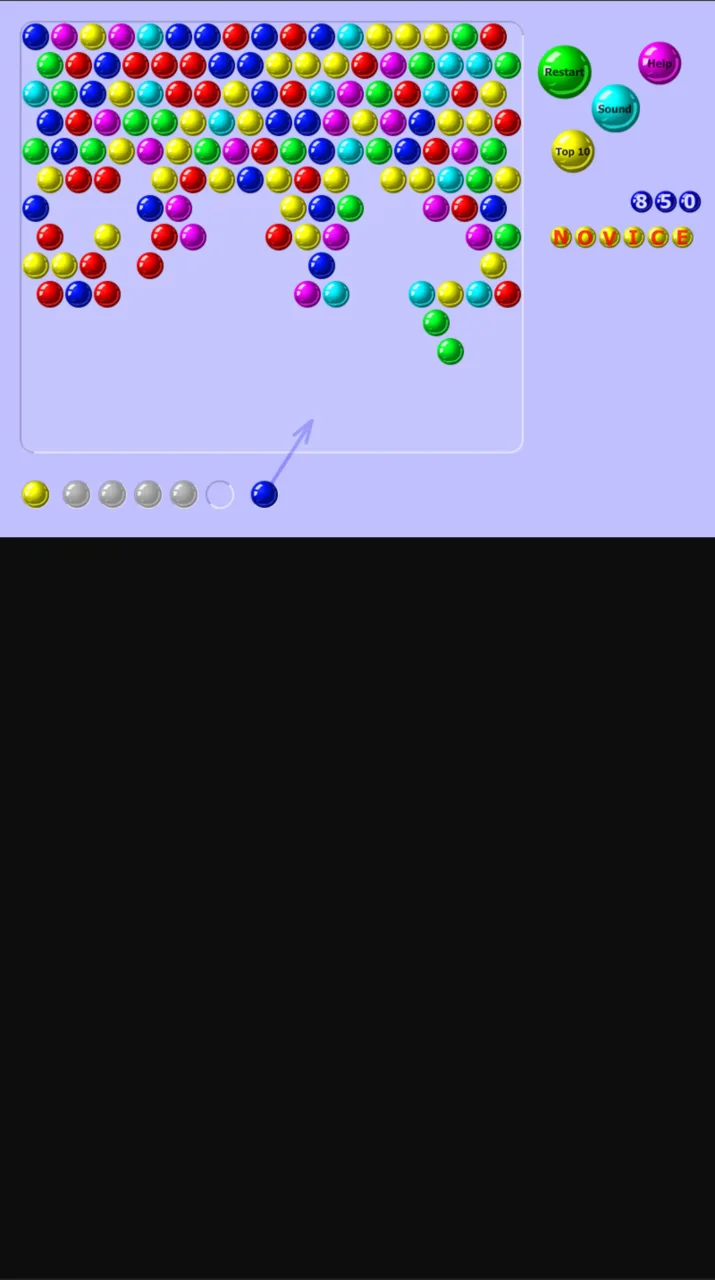
This is a shot from a real phone
Forming Color Matches
The core rule is simple. Match three or more bubbles of the same color and they burst off the board. You aim an arrow cannon at the bottom of the screen, and the trajectory responds as you move. With a mouse, slide left and right to aim, then press the left button to shoot. On mobile, tap and hold on the ball to aim, then tap to shoot.
Look at the colors touching the spot where your bubble will land. A bubble that joins two matching neighbors completes a cluster at once. A bubble that lands beside the wrong color just adds clutter and wastes a shot.
Plan one move ahead. Before you fire, ask which color will sit next in your cannon and where it could go. Small clusters of three feel safe, but they leave the rest of the board untouched. Bigger groups clear more space, so look for spots where one shot can join two separate patches of the same color.
Resist the urge to fire fast. A shot that clears nothing costs you more than a few extra seconds of thought. Patience is your best aiming tool here.
Using Wall Ricochet Angles
Bubbles bounce off the left and right walls, and that bounce opens up bank shots. When a bubble is blocked by a tall column, you can send it sideways into a wall and let it rebound into the gap. This is how you reach colors tucked behind the front line.
Start with gentle angles. Aim toward the wall at a spot near the middle of its height, then watch where the bubble lands. After a few tries, you will judge the rebound by eye. Steep shots near the wall edge are harder to predict, so save them for moments when a direct line does not exist.
Foul Counters and Ceiling Drops
The Miss Penalty Counter
As long as you keep clearing groups, the queue holds steady and you feel safe.
Once the counter reaches zero, the whole playing field shifts downward. A new row of randomized bubbles appears at the top, and your room to move shrinks. That is the ceiling drop, and it is the main source of pressure in the game.
Treat the counter like a tiny health bar. When only a couple of indicators remain, stop experimenting. Pick the shot that you know will burst something, even if it is a small cluster. A guaranteed pop resets the danger better than a clever setup that might fail.
Also watch how new rows change your plan. Fresh bubbles arrive in random colors, so a pattern you built can vanish under a wall of mismatched colors. Keep your options flexible and avoid betting everything on one shot.
Dropping Hanging Bubbles
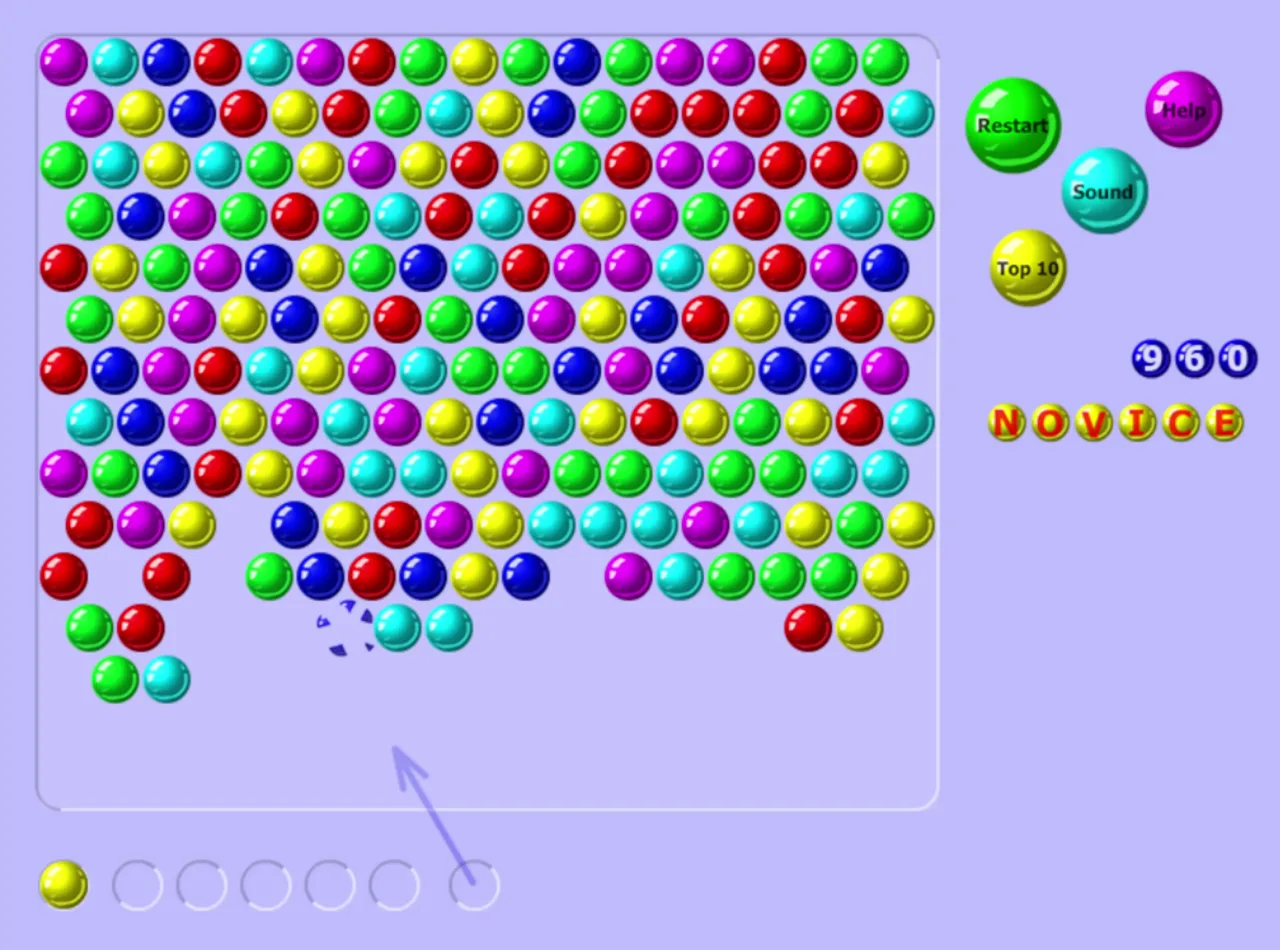
You do not need to match those bubbles at all.
The yellow bubble pops after the blue bubbles finish popping, because it loses its connection to the top part.
That means one well-aimed shot can wipe out a huge mass of mismatched colors. Find the root bubbles that hold a cluster to the ceiling, burst those, and everything below falls away. It is the fastest way to turn a messy board into an open one.
Bubble Shooter Scoring and Win Conditions
Clearing the Entire Board
Big clearing moves score best. A large color match removes many bubbles at once, and an avalanche drop can remove dozens more without a single extra match. Players who chase these big events finish boards faster than those who nibble at the edges one cluster at a time.
Think about the order of your work. Clearing the front row bubble by bubble keeps the board small, but it also gives you little to aim at near the end. Opening a path toward the ceiling anchors lets you drop whole sections in one go.
Keep an eye on the last few bubbles. A single stray color near the top can force awkward bank shots, so try not to leave isolated pieces in hard-to-reach corners.
Baseline Defeat State
Stay ahead of the drops, and defeat stays far away.
Release History and Platform Evolution
Absolutist 2001 Release
Absolutist released Bubble Shooter on March 26, 2001, first as a standalone desktop title for personal computers. The design drew straight from Taito's 1994 arcade game Puzzle Bobble, which set the template for aiming a cannon and bursting same-colored clusters.
The idea spread because it needs almost no explanation. You aim, you fire, and the rules show themselves within one round. After the desktop debut, the game moved to Adobe Flash, where short browser puzzles found a huge audience.
That Flash era helped make the match-3 shooter a familiar genre. Many later versions copied the same basic loop of aiming, bouncing, and bursting.
Migration from Flash to HTML5
As Flash faded, the game moved to HTML5. It supports mouse control on desktop and tap control on mobile, so you can play on whichever screen you have.
Essential Board Management Strategies
Preparing the Next Bubble
Always check which bubble waits in the queue before you fire. Knowing your next color lets you set up a pair of shots instead of treating each one alone. If the current bubble can only make a weak match, think about whether the next one would do better in that spot.
Use the first shot to open space and the second to finish the job. This habit protects your foul counter, because fewer shots go to waste. It also stops clusters from building up in one corner while you chase a single color.
Scan the full width of the board each turn. Large patches of one color are easy to miss when you stare only at the front row.
Tunneling to Support Roots
When a big, messy mass hangs from the ceiling, drill a narrow path toward its anchor points. Burst the bubbles along that path until you reach the roots, then pop them. The whole mass falls in one avalanche, saving you many shots.
Both center on aiming projectile angles from the edge of the screen to clear a ceiling of colored targets, but Block Breaker uses real-time paddle bounces instead of turn-based match-3 bubble shots.
Shares the relaxing puzzle objective of matching identical elements to clear board space and chase a high score, but you slide tiles on a grid rather than aiming and shooting bubbles.
✨ Key Features of Bubble Shooter
Arrow cannon launcher with responsive trajectory targeting
Color-matching mechanics requiring clusters of three or more
Wall bounce physics for angled bank shots
Ceiling drops introducing fresh bubble rows upon consecutive misses
Avalanche mechanic that pops unattached dangling spheres
How to Play Bubble Shooter
Step 1: Aim the Launcher
Move your mouse cursor across the playfield to adjust the trajectory line of the bubble cannon.
Step 2: Launch at Matching Colors
Left-click to launch your loaded projectile toward groups containing two or more bubbles of the identical color.
Step 3: Utilize Wall Ricochets
Bounce shots off the left and right border walls to curve around obstacles and reach awkward overhead clusters.
Step 4: Sever Anchor Points
Target the highest connected root clusters to drop large groups of unsupported dangling bubbles in a single turn.
Step 5: Prevent Baseline Breaches
Maintain low bubble columns across all tracks so descending ceiling rows do not push spheres past the lower boundary line.
Bubble Shooter FAQs
Can I play Bubble Shooter on mobile devices?
Yes. Bubble Shooter runs in your phone or tablet browser, and it has touch controls.
What are the basic controls for Bubble Shooter?
Browser mouse: Move Mouse Left and Right — aim; Left Mouse Button — shoot. Mobile: Tap and hold on the ball — aim; Tap — shoot.
Do I need to download Bubble Shooter?
No. Bubble Shooter runs in your browser on this page, with nothing to download or install.
What causes the bubble ceiling to drop?
Every shot that fails to form a matching cluster of three or more consumes a foul counter marker. When all counter indicators run out, the ceiling descends and introduces an entirely new row of bubbles.
Conclusion
Bubble Shooter is a classic Match-3 puzzle that rewards careful aim and smart planning. Its Foul Counter keeps the pressure on, since too many missed shots push a fresh row of bubbles down the playing field. The Avalanche Drop adds a satisfying payoff, letting a single well-placed shot clear large groups of bubbles.
Whether you play with a mouse or on a mobile device, the controls are simple: aim, then shoot. It runs in your browser, on desktop or mobile, as a single-player experience from Absolutist. Ready to pop some bubbles? Play Bubble Shooter right here on this page and see how many clusters you can bring down.
Bubble Shooter Game Image
Game Controls
Move Mouse Left and Right
Aim
Left Mouse Button
Shoot
Tap and hold on the ball
Aim
Tap
Shoot
No comments yet. Be the first to share your thoughts!



No comments yet. Be the first to share your thoughts!