2048 turns one simple swipe into a full-board puzzle, and every move you make shifts the whole grid at once. You slide numbered tiles, merge matching pairs, and chase one famous number. It sounds easy for about thirty seconds. Then the board starts to fill, and each choice begins to matter.
Here is the good part: the rules fit in one breath, but the strategy runs deep. A single careless swipe can scatter tiles you spent minutes lining up. A calm, planned approach can carry you far past the number in the title. This guide covers how the grid moves, where to park your biggest tile, and how to survive when the board gets tight.
Start playing 2048 now, then use the tips below to push your runs further.
Core Grid Rules and Movement in 2048
The 4x4 Sliding Grid
The board is a 4x4 grid, so you work with sixteen cells. Each input pushes every moveable tile in one direction at the same time. Tiles keep sliding until they hit the edge of the board or another tile. You never move just one number on its own.
That detail changes how you think. Say you want to nudge one tile left. Every other tile on the board slides left too, and some of them land in spots you did not plan for. Good players check the whole grid before each swipe, not just the tile they care about.
On a keyboard, use the Arrow Keys or the WASD Keys to change direction. On mobile, swipe left or right to move the numbers horizontally, and swipe up or down to move them vertically. Whatever device you use, the result is identical.
Merging is the heart of the game. When two tiles with the same value collide, they fuse into one tile holding their combined sum. Two 2s become a 4. Two 4s become an 8. Each merge doubles the value and frees up a cell, which is how you keep room on a crowded board.
Tile Spawning Mechanics
After every legal move, a new tile appears in a random empty square. It shows either a 2 or a 4. You cannot choose where it lands or which number it carries.
This keeps pressure on you. The board fills with small tiles faster than you might expect, so aimless swiping punishes you quickly. A move that changes nothing does not spawn a tile, which means a blocked swipe costs you nothing but also helps nothing. Plan merges that clear space before the next tile shows up.
Corner Anchoring and Chain Building
Locking the Primary Corner
Pick one corner and make it the home of your biggest tile. Many players choose a bottom corner, but any corner works if you stay loyal to it. The idea is simple. A tile in the corner has fewer sides exposed, so it is harder to knock loose.
Why does this matter? Because every swipe moves the whole board. A large tile floating in the middle of the grid can get dragged into a bad spot with one wrong move. Once your top tile sits in the corner, you build everything else around it.
Treat that corner like a vault. Do not pull your biggest tile out unless you have no other legal move. When it stays put, your other tiles gather near it, and your merges start to flow toward one spot instead of spreading across the board.
Building Descending Rows
Line your tiles up along the edge in descending order. Start with the big one in the corner, then the next smaller value beside it, and so on. Picture a staircase running along one side of the board.
This chain makes merging smooth. When the next matching tile arrives, it slides into place and the whole row collapses upward in value. A stray low tile trapped between two large ones, on the other hand, can block your chain for many moves.
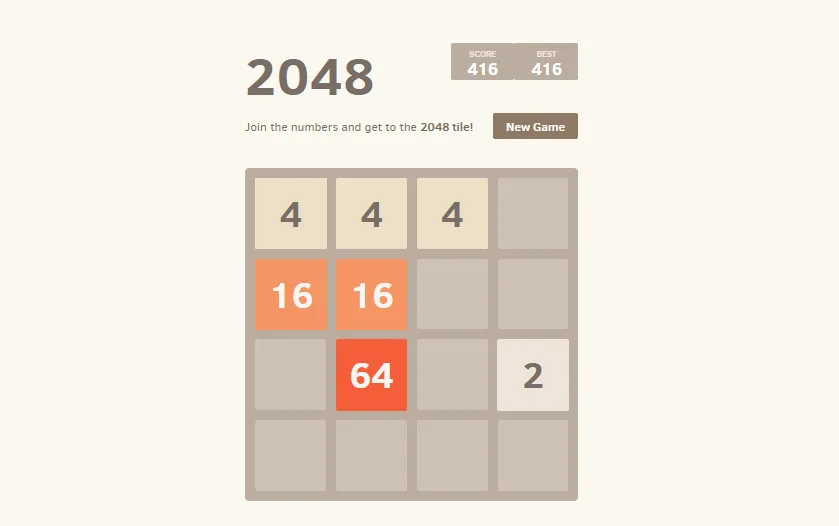
Keep the values in your row close together. A gap, like a 64 next to a 16, leaves holes that are hard to fill.
Restricting Movement Directions
The Two-Direction Baseline
Pick two main directions and stick with them, such as down and right. If your anchor sits in the bottom-right corner, those two swipes keep pushing tiles toward it. Most of your game should be a steady rhythm of those two moves.
The payoff is control. Each time you swipe toward your corner, tiles settle against the edge and merge into your chain. You stop guessing and start following a pattern.
A rogue swipe in the opposite direction does the reverse. It pulls your big tiles out of the corner and scatters the chain you worked to build. One careless move left can undo a dozen good ones.
Handling Emergency Upward Swipes
Sometimes the board jams, and down and right do nothing. Then you may need a third direction. Check first whether a side swipe along your anchor row is safe, since it keeps the big tile on its edge.
Use an upward swipe only as a last resort. Before you do it, make sure your corner row is full, so the big tile cannot slide away. Then swipe back toward your corner right away.
Win Conditions and Board-Lock Endings
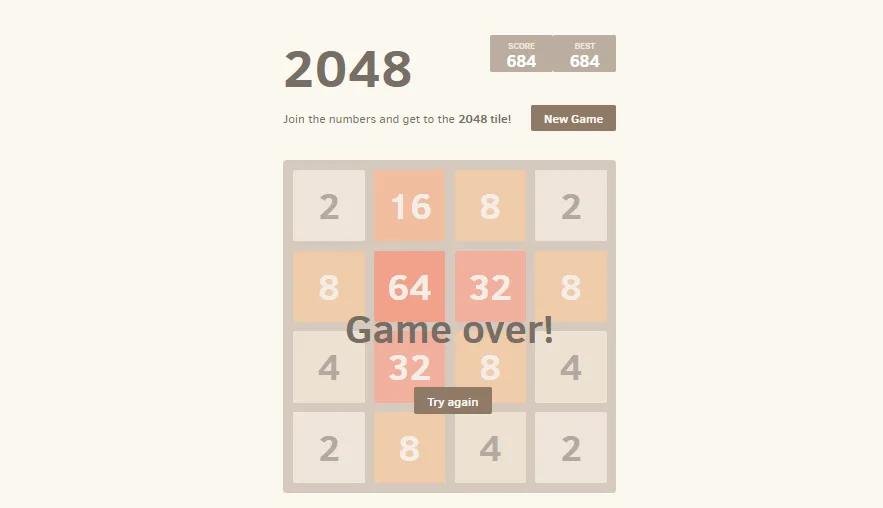
The Game over! message sits over the middle of the board, and the Score box at the top right reads 684.
Reaching the 2048 Milestone
You hit the main goal when you merge two 1024 tiles into a 2048 tile. The climb follows the power-of-two pattern: 2, 4, 8, 16, and onward. Each step needs two matching tiles, so reaching 2048 takes careful, steady merging rather than luck alone.
Scores climb fast as you combine higher values, since each merge adds the new tile's number. That exponential growth is why late merges feel so rewarding. Your corner chain pays off here, because a tidy row lets big tiles collapse in rapid succession.
Do not panic as you approach the target. Many runs fall apart in the final stretch because players rush. Keep the anchor locked, keep the chain ordered, and let the merges come to you.
Endless Play and Loss States
Reaching 2048 does not end the game. Endless continuation mode lets you keep merging past the milestone and chase even bigger tiles.
Try 2048 right here and see how far your chain can grow.
Release History and 2014 Platforms
Open-Source Origin
The game belongs to the sliding tile puzzle genre and runs on plain web technology, which is why it loads fast and plays smoothly.
Because the rules are so compact, many people built their own takes on the idea. Even so, the core remains the same: slide, merge, and fight the random tiles. If you enjoy this kind of thinking, try the other titles in our Puzzle collection, such as Suika Game.
Mobile and Web Ecosystem
2048 runs directly in the browser, so you can start without installing anything. It also works on mobile, where swipes replace the keyboard. Browse the New page for fresh games to try next.
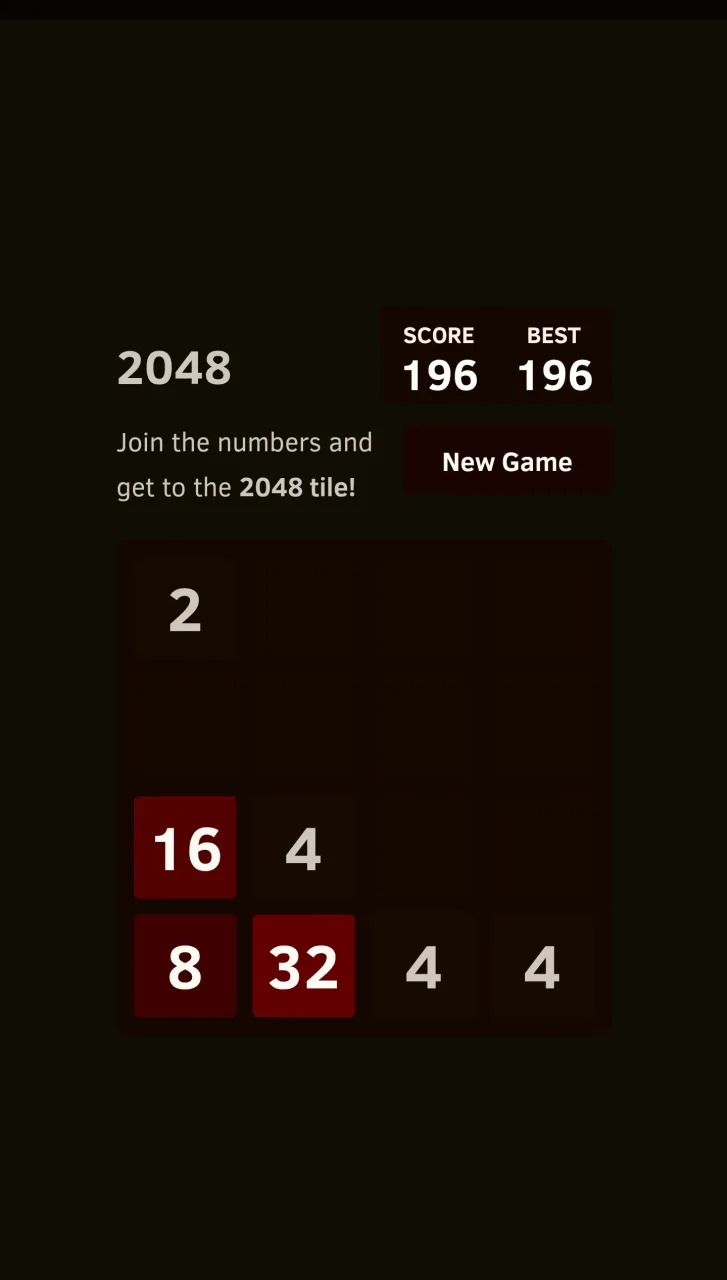
Screenshot of the game on a real phone, The board shows a 4x4 grid with tiles 2, 16, 4, 8, 32, 4 and 4, and the score reads 196.
✨ Key Features of 2048
Sliding tile math puzzle played on a 4x4 grid
Exponential score scaling from combining matching powers of two
Random spawning of 2 and 4 tiles in open cells
Endless continuation mode after reaching the 2048 tile milestone
How to Play 2048
Step 1: Use the game controls
Use Arrow Keys to change direction. Use WASD Keys to change direction. Use Swipe Left or Right to move the numbers horizontally.
Step 2: Survey the Initial Grid
Inspect the two starting tiles on the 4x4 grid before making your first move.
Step 3: Pick an Anchor Corner
Choose one corner, such as the bottom-right, to house your largest numerical value throughout the run.
Step 4: Slide Identical Numbers Together
Use the arrow or WASD keys to slide matching numbers into each other to form doubles like 4, 8, and 16.
Step 5: Limit Your Movement Directions
Stick primarily to two perpendicular directions, such as down and right, to avoid dislodging your highest tile.
Step 6: Maintain Descending Tile Chains
Arrange numbers in decreasing order along your primary edge so consecutive merges flow smoothly into your corner.
Step 7: Keep Playing Past 2048
After fusing the 2048 tile, select the option to keep going to pursue higher milestones like 4096 before the grid locks.
Keyboard: Arrow Keys or WASD Keys - change direction. Touch: Swipe Left or Right - move the numbers horizontally; Swipe Up or Down - move the numbers vertically.
Can I play 2048 on mobile devices?
Yes. 2048 runs in your phone or tablet browser, and it has touch controls.
Do I need to download 2048?
No. 2048 runs in your browser on this page, with nothing to download or install.
How does a run end in 2048?
Creating a tile with the number 2048 counts as a technical win, but you can continue playing indefinitely. A run ends in defeat when all sixteen grid spaces fill and no adjacent matching tiles can merge.
Conclusion
2048 turns a simple sliding tile puzzle into a lasting test of planning. Every move pushes the entire grid in one direction, so you can never fix just one number. Merging matching tiles into their combined sum frees up space and carries you toward 2048 and beyond, while a new 2 or 4 appearing after each move keeps the pressure on.
It's easy to learn and hard to put down. Use the Arrow Keys or WASD on a keyboard, or swipe on a mobile screen, and the HTML5 build runs right in your browser. Think a few moves ahead and the board rewards you.
Ready to see how high you can climb? Start playing 2048 here on this page and chase that next merge.
2048 Game Image
Game Controls
Arrow Keys
Slide Tiles
WASD Keys
Slide Tiles
Swipe Left or Right
Slide Tiles Horizontally
Swipe Up or Down
Slide Tiles Vertically
No comments yet. Be the first to share your thoughts!



No comments yet. Be the first to share your thoughts!